Data-driven pages
Build a live dashboard from an HTML document that reads JSON files in the same workspace, using the window.draftmesh bridge. Complete worked example.
An HTML document can read JSON files from its own workspace and refresh itself when the data changes. That turns a workspace into a small live dashboard: the numbers live in a .json file anyone (or any agent) can update, and the .html page presents them.
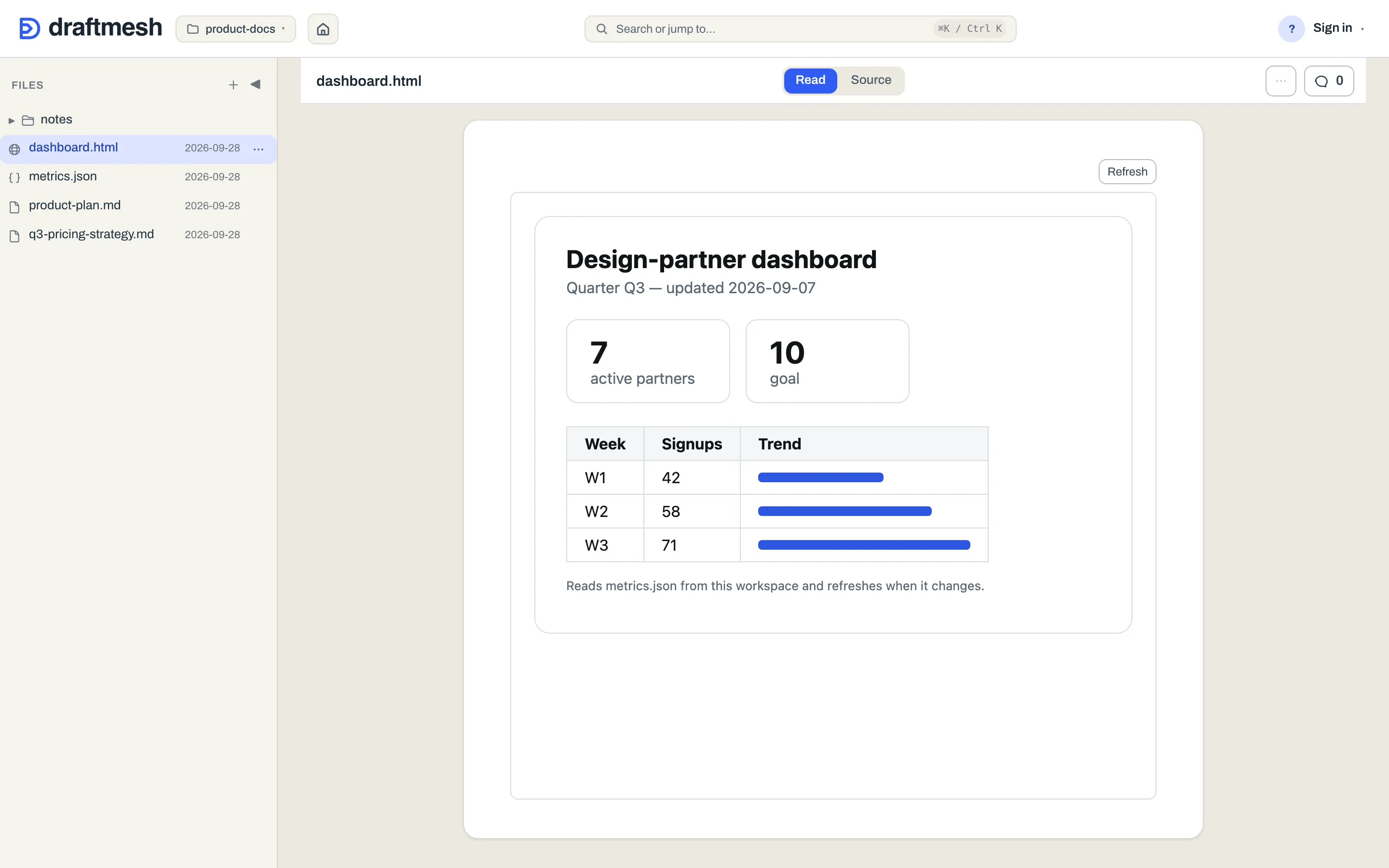
How a page reads data
Inside a DraftMesh-rendered HTML document, a window.draftmesh bridge is available:
window.draftmesh.readJson(path)— returns a Promise of the parsed contents of a JSON file in the same workspace (the path is relative to the workspace root, e.g."metrics.json"or"data/sales.json").window.draftmesh.writeJson(path, data)— asks to savedataback to a JSON file in the same workspace. You decide: DraftMesh shows a confirmation naming the file and previewing exactly what would be written, and nothing is saved unless you approve it. See Saving data from a page below.window.draftmesh.onDataChange(path, callback)— calls your callback whenever that file changes, so the page can re-read and re-render. No polling needed. Omit the path (onDataChange(callback)) to hear about every data file in the workspace; the callback is handed the path that changed. It returns a function that unsubscribes.
Pages can only touch .json files from their own workspace — the bridge is not a general file or network API.
A complete example
Create metrics.json:
{
  "quarter": "Q3",
  "signups": [
    { "week": "W1", "count": 42 },
    { "week": "W2", "count": 58 }
  ]
}
And dashboard.html:
<!doctype html>
<html>
<head><meta charset="utf-8"><title>Signups</title></head>
<body>
<h1>Signups</h1>
<div id="out">Loading…</div>
<script>
  function render(data) {
    document.getElementById("out").textContent =
      data.quarter + ": " +
      data.signups.map(function (s) { return s.week + "=" + s.count; }).join(", ");
  }
  function load() {
    window.draftmesh.readJson("metrics.json").then(render);
    window.draftmesh.onDataChange("metrics.json", function () {
      window.draftmesh.readJson("metrics.json").then(render);
    });
  }
  if (window.draftmesh) { load(); } else { window.addEventListener("draftmesh-ready", load); }
</script>
</body>
</html>
The last line is the recommended startup pattern: use the bridge if it’s already there, otherwise wait for the draftmesh-ready event.
If a read fails, the Promise rejects with a reason you can show honestly: not_found (no such file), invalid_json (the file doesn’t parse), or unsupported_path (not a .json file in this workspace).
Saving data from a page
An interactive page — a cost model with editable inputs, a planning board — can offer a real Save button:
saveButton.onclick = function () {
  window.draftmesh.writeJson("metrics.json", currentState).then(
    function () { statusEl.textContent = "Saved."; },
    function (err) {
      statusEl.textContent = err.message === "denied" ? "Not saved." : "Couldn't save (" + err.message + ").";
    }
  );
};
Calling writeJson never writes anything by itself — it asks. DraftMesh (not the page) shows a confirmation dialog naming the target file with a preview of the exact JSON that would be written; the save only happens when you approve it, and it lands as a normal versioned change attributed to you, so history and rollback apply. Every open page watching that file then refreshes through onDataChange as usual.
Details worth knowing:
- The target file must already exist — pages can update data stores, not create files (
not_foundotherwise). - Declining the dialog rejects the Promise with
denied; treat it as a normal answer, not an error. - If the file changed between the preview and your approval, the save is refused with
conflict— re-read and ask again. - One ask at a time per page (
busy), values must serialize to JSON (invalid_data), and very large payloads are refused (too_large). - The bridge works in the full DraftMesh app. On the phone reader, pages render and links work, but the data bridge doesn’t answer yet — a
readJsonorwriteJsonPromise there never settles, so don’t leave your page’s UI waiting on one without a visible idle state.
Linking to other documents
A page can link to other documents in its workspace with an ordinary relative link — <a href="board.html">, <a href="../specs/plan.md#goals"> — and DraftMesh opens the target in the app, exactly as clicking it in the document tree would. Paths resolve against the page’s own location; a leading / means the workspace root. A prototype index page that points at sibling boards, or a dashboard that links to the documents it summarises, needs nothing more than the links themselves.
Scripts can do the same with window.draftmesh.navigate(path, section), where path is relative to the workspace root and the optional section is a heading slug in a markdown target to scroll to:
window.draftmesh.navigate("design/boards/checkout.html");
window.draftmesh.navigate("specs/plan.md", "goals");
Only links to documents are followed: a link to a path outside the workspace (../../elsewhere) or to a file DraftMesh doesn’t treat as a document is ignored, an absolute URL is left to the page’s sandbox as before, and there is no way for a page to open another workspace. In-page #anchors behave as usual, and a click the page’s own script handles first (calling preventDefault) is left to it. Links work in the full app, on a dashboard or prototype landing page, and in the phone reader; the #section part is followed in the full app’s document view when the target is a markdown document — elsewhere, and for an HTML or JSON target, the document opens at the top.
Dashboards and prototypes
A workspace built around one of these pages can say so. Setting its kind to Dashboard or Prototype (see Workspaces & sync) changes what you see when you open it — the page Home comes back to: instead of the folder list and Workspace map, the workspace leads with its entry page — index.html, or the single .html document at its root — given the whole document area rather than the box a page gets inside a document card. The ordinary document view of that same file, with its comments, history and sign-off, is one click away and unchanged.
The two kinds share the shape and differ in intent, which is what sits beside the page:
- Dashboard — a view over data. Its
.jsondata documents are listed alongside the page, so what it reads is visible without hunting through the tree. - Prototype — the subject of a review. Its sign-off state leads instead: whether an approval was asked for and where it stands. The decision itself is made in the document view, as it always is — the landing page reports, it doesn’t decide.
Creating one scaffolds the starter: a dashboard gets index.html plus a data.json already wired to readJson / onDataChange / writeJson; a prototype gets index.html. Neither kind restricts what else you keep in the workspace.
Pages can use sibling JavaScript and CSS files. Reference them with <script src="./app.js"></script> and <link rel="stylesheet" href="./style.css">. Relative JavaScript imports and CSS imports are bundled into the rendered snapshot; .js and .css files sync and open as source. Missing or inaccessible dependencies prevent the page from loading. Local images/fonts in CSS, package imports, dynamic imports, and local integrity attributes are not supported by this bundling. Inline HTML scripts and styles continue to work. Scripts, stylesheets, images and fonts from other web addresses do not load, and a page cannot make network requests; images and fonts must be inline data: URLs. The window.draftmesh bridge still answers reads on a landing page; saving through writeJson needs the confirmation dialog the document view carries, so do that from the document view.
Updating the data
Anything that changes the JSON file updates every open page watching it:
- In DraftMesh — open the
.jsonfile in Source and edit it. Saves are validated, so you can’t ship a syntax error to your dashboards. - Any other tool — the file is just a file. Edit it in your code editor, write it from a script or a scheduled job; DraftMesh notices the change on disk, versions it, and notifies open pages.
- An AI assistant — a connected agent can update the file with its document-saving tool, with the same validation and the change attributed to the agent in history. See AI assistants.
Every update lands in version history, so a bad number can always be traced and rolled back.